Satya Nadella Just Changed the AI Conversation | Here's What Matters
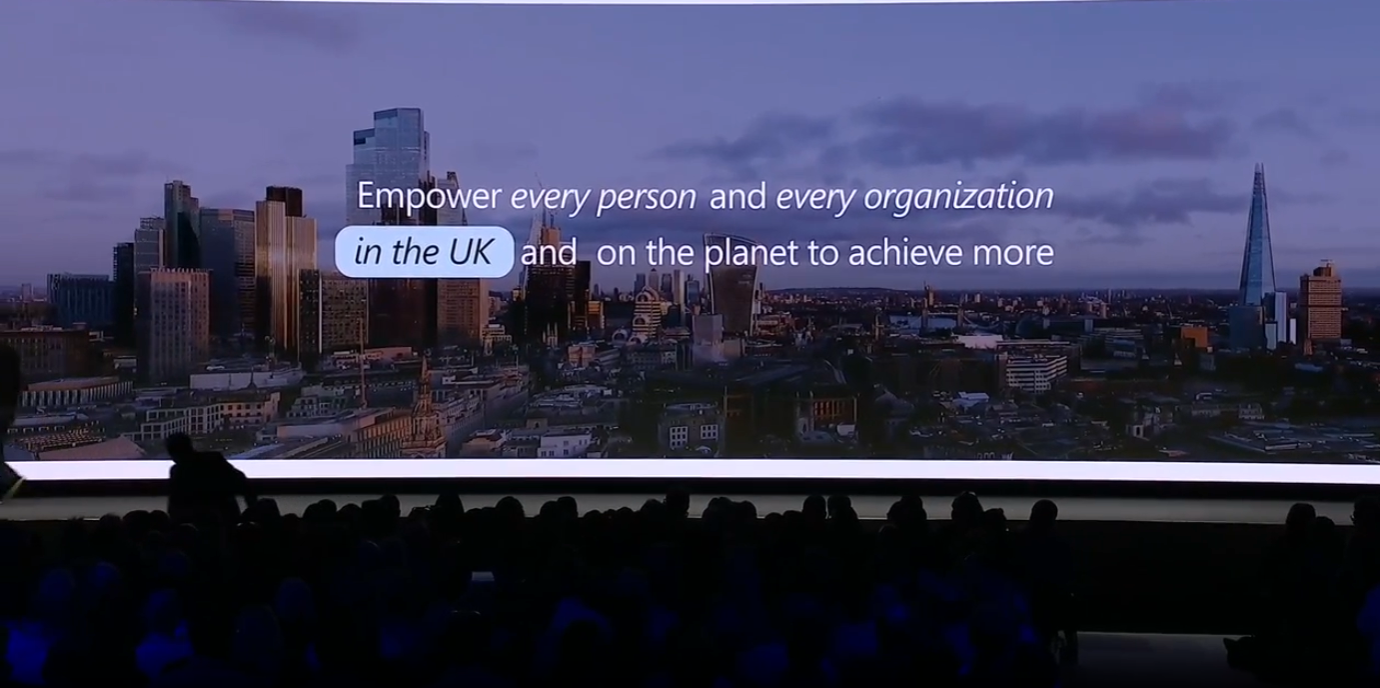
My key takeaways from Microsoft's Frontier Tour London, and why its vision for AI agents, organisational intelligence and the future of work reinforces my thinking behind Scenic Mind and the Third Brain.
I attended Microsoft Frontier Tour London, where Satya Nadella outlined Microsoft vision for the next phase of artificial intelligence.
There was plenty of impressive technology on display, but what interested me most wasn't another model announcement or a new Copilot feature.
It was the bigger picture emerging.
AI is moving from something we interact with to something that actively participates in how we work.
We're moving beyond asking a chatbot questions or generating content. We're entering a world where AI can understand context, retain knowledge, reason through problems, coordinate activities and increasingly execute work on our behalf.
For me, that represents a much more significant shift than simply making existing tasks faster.
Here are the key messages I took away from the keynote, and why I think they matter.
1. Microsoft Wants Copilot to Become the Operating System for Work
One of the clearest messages was Microsoft's ambition to make Copilot much more than a productivity assistant.
The vision brings together four capabilities:
- Chat: Interacting with AI to find information, explore ideas and get answers.
- Cowork: Working alongside AI to plan, coordinate and complete more complex activities.
- Code: Using AI to develop software and create solutions.
- Autopilot: Allowing agents to undertake defined activities with greater autonomy.
The demonstrations showed how these capabilities could work together, from producing leadership briefings and planning activities to coordinating follow-up actions through Teams.
The important point isn't any individual feature.
It's the transition from AI as a tool you use to AI as a capability embedded within the way work gets done.
Think about how most people use AI today. They open an application, write a prompt, receive an answer and then manually do something with that output.
Now imagine the AI already understands the project you're working on, the decisions previously made, the people involved and the next actions required.
Rather than simply answering your question, it can help move the work forward. That's a fundamentally different proposition.
2. Organisational Knowledge Is Becoming a Strategic Asset
One of the most thought-provoking parts of Nadella's keynote was his discussion of what he described as the reverse information paradox.
As organisations increasingly use AI to perform work, there is a risk that valuable knowledge becomes fragmented across conversations, prompts, documents and individual interactions.
People may be using AI extensively, but how much of the knowledge generated through those interactions is actually retained by the organisation?
Consider a business analyst working through a complex problem with AI.
Over several sessions, they might explore business processes, challenge assumptions, evaluate solutions, identify risks and reach important conclusions.
The final deliverable might be a requirements document or business case.
But what happens to all the reasoning that led to it?
Why was one option rejected? Which assumptions were challenged? What evidence informed the recommendation?
That knowledge has real value, yet much of it can disappear once the conversation ends.
The organisations that succeed with AI won't simply be those that generate the most content. They'll be the ones that capture, connect and reuse what they learn.
This is particularly relevant to the work I'm doing with Scenic Mind.
I've become increasingly interested in how AI can provide continuity of knowledge, not just isolated answers.
Because intelligence without memory has limitations.
3. AI Agents Are Moving Beyond Demonstrations
Another important theme was the shift towards agentic AI.
An AI agent is more than a chatbot with a sophisticated prompt. It can be given an objective, access relevant information, use tools and undertake a sequence of actions to achieve an outcome.
Microsoft highlighted examples across several industries, including healthcare, aviation, manufacturing and customer services.
The NHS examples were particularly interesting, with discussion of how AI can support operational decision making and help professionals identify appropriate care pathways.
Rolls-Royce was another example, illustrating how AI can support complex activities such as maintenance planning.
The value here isn't necessarily about replacing people.
It's about helping organisations handle complexity, reduce administrative effort and give professionals more time to focus on decisions that require human judgement.
However, I think there's an important distinction between an agent that performs an impressive demonstration and one that delivers reliable business value.
Real organisations operate with imperfect data, exceptions, conflicting priorities, legacy systems and changing requirements.
An agent must be able to operate within those realities.
That means organisations need to think beyond the technology and consider process design, accountability, integration, governance and how success will be measured.
The opportunity isn't simply to automate tasks. It's to rethink how work should be performed when people and AI can collaborate.
4. Microsoft Foundry & The Move Towards Connected Intelligence
Microsoft also discussed the growing importance of its Foundry platform and the different layers of intelligence needed to support enterprise AI.
Concepts such as Work IQ, Web IQ and Foundry IQ point towards a future where AI systems can draw on different sources of context rather than operating as isolated applications.
This matters because one of the biggest limitations of AI today isn't always the quality of the underlying model. It's the information available to it.
A powerful model that doesn't understand your business, your customers, your processes or your previous decisions can only provide so much value.
By contrast, an AI system with access to relevant, well-governed organisational knowledge can become considerably more useful.
Microsoft's approach also recognises that organisations may need different models for different purposes, rather than relying on a single model for everything.
I see this as an important development.
The future of enterprise AI is unlikely to be one chatbot containing everything.
It's more likely to involve connected capabilities, shared context, specialist agents and systems that can work together.
For organisations, the challenge will be designing that environment so information remains accurate, accessible, secure and useful.
And that requires good architecture and good business analysis, not just good prompting.
5. Trust, Security & Human Control Must Be Built In
Satya framed the next phase of AI around three important challenges: empowering individuals, retaining organisational knowledge and establishing trust.
As AI agents gain greater access to information and the ability to take action, the questions around control become more important.
Microsoft's discussion of Agent 365, agent identity, monitoring, security and governance highlighted the scale of that challenge.
If an organisation has hundreds or thousands of AI agents operating across its systems, it needs to understand what those agents can access, what they're doing, what they cost and who is accountable for their actions.
These aren't optional considerations. They're essential to making agentic AI sustainable.
I'm particularly interested in the balance between autonomy and human control.
Not every decision should be delegated to an agent, even when the technology is capable of making it.
Some activities can be automated with very little oversight. Others require approval, professional judgement or a clear audit trail.
The key is understanding the difference.
Good AI adoption isn't about removing humans from every process. It's about applying human judgement where it adds the greatest value.
6. Why This Reinforces My Thinking Behind Scenic Mind & The Third Brain
The most interesting aspect of the keynote for me was how closely Microsoft's direction aligns with something I've been developing through Scenic Mind.
I call it the Third Brain.
The idea is relatively simple.
We have our own human intelligence, supported by the knowledge, experience and judgement we've developed throughout our lives.
We also have the systems and tools we use to organise information and carry out work.
The Third Brain builds on these by introducing a connected AI capability that can help us remember, reason, act and learn.
My thinking is built around four core capabilities.
👉 Memory
AI should help retain and retrieve relevant knowledge, including previous decisions, conversations, documents and the context behind them.
👉 Reasoning
AI should help us explore problems, challenge assumptions, evaluate alternatives and develop better informed conclusions.
👉 Execution
AI should help turn thinking into action, whether that's creating deliverables, coordinating activities, automating processes or working with other systems.
👉 Reflection
AI should help us review outcomes, learn from experience and improve how we approach similar situations in the future.
These capabilities become much more powerful when they work together.
Imagine a business analyst starting a new initiative.
Rather than spending days locating documents, interviewing people to rediscover past decisions and reconstructing the history of a project, their Third Brain could help assemble that context.
It could identify related initiatives, highlight previous lessons, suggest questions worth exploring and help structure the discovery process.
As the work progresses, it could retain decisions and their rationale, support requirements analysis, prepare documentation and coordinate agreed actions.
At the end, it could help evaluate what worked, what didn't and what the organisation should remember for next time.
The business analyst still owns the thinking, relationships, decisions and outcomes.
But they have a capability working alongside them that reduces the effort required to manage information and increases the time available for meaningful analysis.
That's the future I find exciting, and importantly, I don't think the Third Brain should be limited to business analysts.
The same principles can apply to product managers, operational leaders, consultants, business owners and anyone whose work depends on knowledge, judgement and getting things done.
7. AI Maturity Should Be Measured by Outcomes, Not Usage
There's one final point I think deserves more attention.
As organisations invest in AI, it's tempting to measure success through adoption statistics.
How many people have access to Copilot? How many prompts are being submitted? How many agents have been created?
Those numbers may tell us something about activity, but they don't necessarily tell us whether the organisation is becoming more effective.
A business can have thousands of employees using AI every day without fundamentally improving how it operates.
For me, meaningful AI maturity is about the quality of application.
Are people making better decisions? Are processes improving? Is valuable knowledge being retained? Are customers receiving better experiences? Is the organisation achieving measurable business outcomes?
These are much more useful questions.
It's also why I believe AI adoption needs to be approached as a business transformation challenge, not simply a technology deployment.
My Final Thoughts
I came away from Microsoft's Frontier Tour London with the sense that the AI conversation is becoming more mature.
The focus is moving beyond what a model can generate towards what people and organisations can actually achieve with AI.
Microsoft is clearly building a substantial ecosystem around that vision, from Copilot and Foundry through to agents, connected knowledge and enterprise governance.
But the technology is only one part of the equation.
Organisations still need to understand their problems, design effective processes, develop their people and establish the right controls.
For me, the biggest opportunity is the development of AI capabilities that provide continuity between what we know, how we think, what we do and what we learn.
That's the thinking behind Scenic Mind and the Third Brain.
And after hearing Satya Nadella's vision in London, I'm even more convinced that this is where the real value of AI will emerge.
The future isn't simply about having access to more artificial intelligence. It's about using that intelligence to make human capability more effective.
Neil Terry | Scenic Mind
Exploring practical AI adoption, intelligent automation, business transformation and the Third Brain.
#ArtificialIntelligence #MicrosoftCopilot #SatyaNadella #AgenticAI #FutureOfWork #ScenicMind #ThirdBrain #BusinessTransformation